




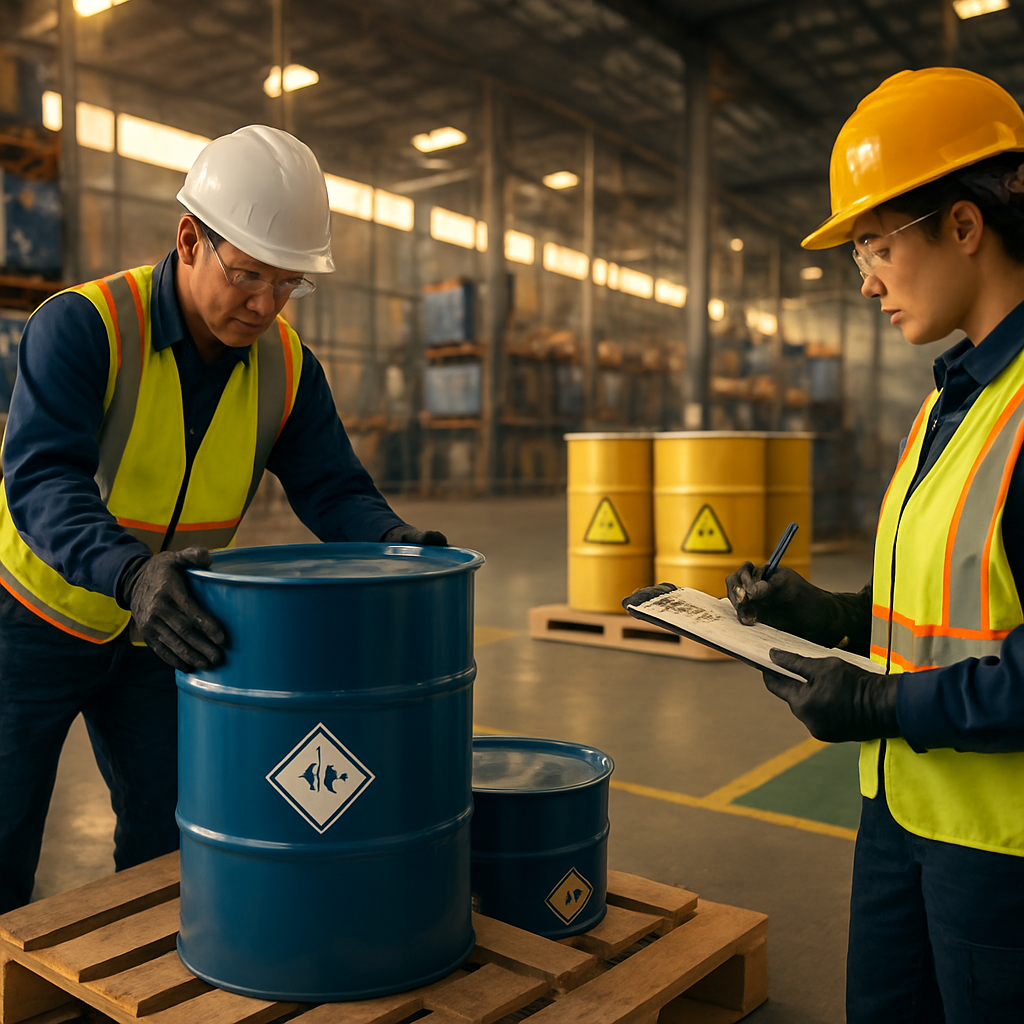
Chemical Freight Transport: Safety Standards and Regulations
Chemical Freight Transport: Safety Standards and Regulations is moving rapidly up the risk agenda for Australian supply chains. With ADG Code Edition 7.9 becoming mandatory from 1 October 2025, boards and executives can no longer treat compliance as a back-office function. As networks stretch across mining, agriculture, health care and manufacturing, any failure in controls now carries amplified legal, financial and reputational consequences, particularly where Hazardous Goods in Australia intersect with urban communities and critical infrastructure.
Chemical freight risk has become a strategic question about licence to operate, not just a question of passing audits or updating labels.
Leaders who recognise this shift are reframing dangerous materials handling as part of enterprise risk management, on par with cyber security and climate exposure. They are mapping their exposure across consignors, loaders, drivers and subcontractors, then using data to test whether documented chemical freight safety procedures actually work under pressure. This mindset is crucial as regulators sharpen expectations around incident reporting, due diligence and demonstrable governance over complex carrier networks.
Chemical Freight Transport: Safety Standards and Regulations in Practice
At the operational level, Chemical Freight Transport: Safety Standards and Regulations are defined primarily by the ADG Code for road and rail, supported by CASA for air and AMSA for sea. The challenge for freight operators is not simply knowing the rules, but aligning shipping regulations for chemicals across multiple modes, depots and jurisdictions. Progressive operators are building unified control frameworks that integrate australian chemical shipping rules, hazardous cargo handling guidelines and documented safety protocols for transport into a single, auditable system.
From Compliance Checklist to Strategic Risk Intelligence
The most advanced organisations are treating compliant chemical transport standards as a baseline, then going further to extract insight from near misses and minor spills. By aligning internal reports with open datasets such as Queensland’s dangerous goods incident statistics on the official government site at https://www.worksafe.qld.gov.au/, leaders can identify patterns and implement dg transport risk controls that focus on real-world failure modes. This data-driven approach supports dangerous goods transit safeguards like smarter route selection, higher-spec equipment in high-risk corridors and targeted upskilling of front-line staff.
As ADG 7.9 approaches, the question is less “Are we compliant?” and more “Can we prove our safe hazmat logistics practices across the entire chain of responsibility?” Executives should commission readiness reviews that stress-test documentation flows, training effectiveness and emergency playbooks against regulated chemical freight requirements. The most effective next step is a structured board-level discussion that reassesses risk appetite, clarifies accountability and sets a roadmap for continuous improvement in Chemical Freight Transport: Safety Standards and Regulations.
To strengthen your position before the new rules take full effect, review your current freight risk strategy, test it against recent incidents, and speak with a specialist to benchmark your controls against emerging best practice in Australia’s chemical freight sector.

Related posts

12 Dangerous Goods (DG) energy storage units from China to the Bellevue Gold Mine site in Sir Samuel, WA
Across the Ocean Shipping is proud to announce the successful delivery of 12 Dan
The Cost of Non-Compliance in Hazardous Goods Transportation: Lessons Learned
Transportation of hazardous goods is a critical part of the modern economy, from
Essential Compliance for Dangerous Goods Freight Forwarding
Dangerous goods freight forwarding in Australia is under pressure. Learn the key
